Built for AV companies, brand activations, and touring crews
Lights, video and timecode from one seat.
CueSync Production Edition pairs AutoPilot + CueStack in the same show file, keeps the two engines from ever double-firing a beat, and surfaces connection health + predictive preview so the lead operator sees problems before they reach the audience. Every integration in every show — no per-protocol licensing math, no middleware boxes.
CueSync/Timecode
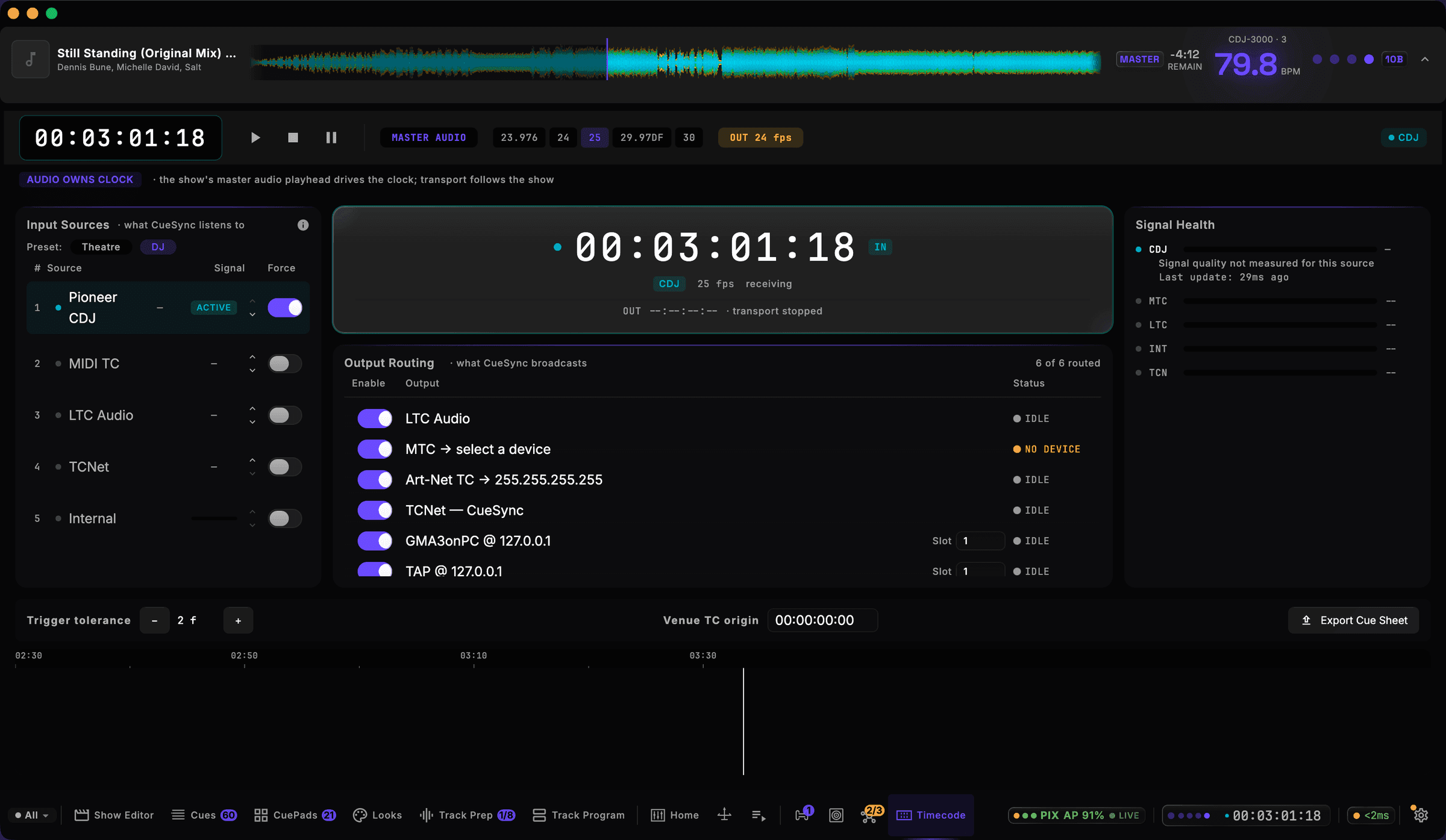
- Five input sources ranked — the Pioneer CDJ active
- Audio owns the clock; the transport follows the show
- Six of six routes — LTC, MTC, Art-Net, TCNet, GMA3, TAP
Captured live from a connected Pioneer CDJ-3000 — not a mock-up or a render.
Six capabilities event teams actually use
Production Edition consolidates the work your specialists do manually today. It doesn't replace the artists in the booth — it removes the translation layer between them.
AutoPilot + CueStack combined
The music-reactive engine and the cue-list engine run side by side in the same show. A scripted opening, a DJ-led main set, a beat-locked finale — one platform, no swapping software.
No double-fires between engines
AutoPilot tells the cue stack what it has just fired, so beat and phrase cues do not double up on the same beat, and a manual GO or operator override always fires.
Connection status you can see
Outputs reconnect automatically after a dropped connection, with connection status shown in the app and failed sends reported per device where the protocol can tell. Spot the flaky link before it becomes a stranded fixture.
Predictive Preview
See what your lighting and visuals will do before the cue fires — the next few bars of beat-driven automation, shown in the preview HUD so the operator can override before the audience sees it.
All integrations in every show
grandMA2/3, Resolume, disguise, VIOSO, Pixera, TouchDesigner, Unreal Engine 5, QLab, Avolites Titan, ETC Eos, ChamSys MagicQ, Pangolin Beyond, TCNet, MIDI, OSC, MIDI Show Control, plus Art-Net/sACN DMX-over-IP. The same operator, every integration, every event.
Priority support
Your ticket goes to the front of the queue and is answered by the engineers who build CueSync — not a first-line script reading from a macro. Included with Production Edition.
CueSync Production vs multi-operator coordination
What one platform takes over, and where a specialist in the booth still matters.
With CueSync Production
Multi-operator setup
Operator headcount per show
CueSync — 1 operator runs lighting + video + timecode fanout
Without — Separate operators per protocol — lighting op, video op, audio op
Multi-protocol routing
CueSync — Every integration available, every show, no per-protocol licensing math
Without — Mix of console-native, custom Lua/OSC patches, and middleware boxes
Show-network confidence
CueSync — Predictive Preview + honest connection status surface issues before curtain
Without — Operator walks the rig, hand-checks each output, hopes nothing drifted
Cross-stage coordination
CueSync — One machine per stage on a shared timecode clock; a team licence seats three at once
Without — Verbal call-outs and timecode feeds with nothing keeping two engines from doubling a look
Marquee creative direction
CueSync — Authors your team's design choices — doesn't generate them
Without — Your senior LD, video engineer, or designer driving the vision live
Per-event setup time
CueSync — Venue auto-recognition + pre-show review
Without — Patch-by-patch walk-the-rig before every load-in
Event production questions
How do multiple stages or venues run together?
Each stage or venue runs CueSync on its own machine and fires the rig it owns; they stay in step by sharing a clock — one source generates LTC, MTC, Art-Net timecode or TCNet and the others chase it, or every machine follows the same Ableton Link session. Within a machine, AutoPilot tells the cue stack what it has fired so beat and phrase cues do not double up, and manual GOs and operator overrides always fire. Each machine needs a licence seat; a team plan includes three that can all drive live output at once. See the reliability page for the broader live-show resilience story.
Can we integrate CueSync into our existing show-control workflow without replacing tools?
Yes — that's the point. CueSync sits alongside your grandMA3 console, your Disguise media server, your Resolume rig, your QLab audio cues, and your timecode generator. It speaks each one's protocol natively (TCP / OSC / MIDI / MSC, plus Art-Net/sACN DMX-over-IP) and translates beat / phrase / timecode events into the right call for the right system. Nothing gets replaced; the work that gets reclaimed is the manual translation layer.
What if our event has complex Disguise + GMA3 + Resolume + audio routing?
Production Edition was designed for exactly this case. AutoPilot and the cue stack do not double-fire beat and phrase cues; the Predictive Preview lets the lead operator see the next few bars before they hit; every output recovers automatically with honest connection status. The 15 output protocols cover everything in that stack natively — no middleware hops between disguise OSC, your GMA3 console, and Resolume.
What about broadcast events with frame-accurate timecode requirements?
Production Edition includes Theatre Edition's full timecode stack: generate frame-accurate LTC, MTC, Art-Net timecode and TCNet, and chase an incoming LTC, MTC, Art-Net or TCNet master — or the CDJ itself over PRO DJ LINK. The reverse-timecode policy is configurable per cue so jog-wheel scrubbing in QLab doesn't fire dependent cues backwards. Routing failures surface as operator-visible warnings rather than silent runtime drops.
One platform for the season.
Production Edition is $55/mo or $499/yr, excluding tax. Refund window: 14 days on monthly, 30 days on annual and lifetime. See the refund policy for details, or write to sales for fleet pricing.
See also
CueSync for Festival StagesCueSync for Theatre OperatorsTimecode Calculator (free tool)DMX Universe Planner (free tool)disguise IntegrationUnreal Engine 5 IntegrationLooking at ShowKontrol?Looking at Clockworks?Looking at Chataigne?Who Owns Timecode When disguise Is in the Rig?Automating Avolites Titan Playbacks from the Music