Built for festival production teams and multi-stage events
One Mac per stage. One shared clock.
CueSync Production Edition runs one machine per stage, locks every stage to one timecode source, and fans each cue out to the console, media server and laser that stage owns. Predictive Preview keeps the lead operator ahead of trouble before the audience sees it.
CueSync/Looks
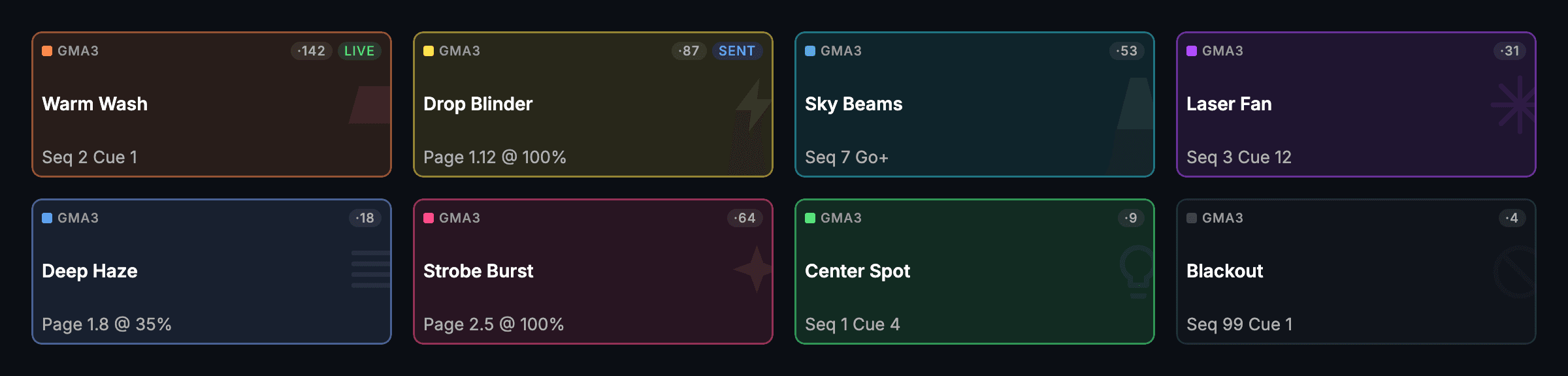
- Eight Looks, each bound to a grandMA3 sequence or page
- Warm Wash live, Drop Blinder sent — state on the tile
- Release state per tile, so nothing is left on the rig
Six capabilities festival production teams actually run
What ships today on Production Edition, described in operator terms. Opt-in features are clearly marked.
A machine per stage, one shared clock
Each stage runs CueSync on its own machine and fires its own rig. Chase the same LTC, MTC, Art-Net or TCNet feed — or follow the same Ableton Link session — and every stage agrees on where the show is. Inside each machine, AutoPilot and the cue stack do not fire the same beat twice for beat and phrase cues, so a main stage can run AutoPilot while a side-area stage runs a scripted cue stack. A team licence puts up to three machines on live output at once.
PRO DJ LINK on every Pioneer stage
Each stage's CueSync instance joins that stage's PRO DJ LINK network as a virtual deck. Reads beat phase, BPM, master tempo, and track metadata directly over Ethernet — no per-stage middleware and no audio-only guesswork.
Frame-accurate timecode across stages
Generate LTC, MTC, Art-Net timecode and TCNet, or chase an incoming LTC, MTC, Art-Net, TCNet or CDJ master. Lock the broadcast feed, the lighting timeline, and the video playback to one clock so cross-stage IMAG cuts land on the same frame everywhere.
Predictive Preview
The Predictive Preview HUD shows the next few bars of beat-driven automation before they fire, so the lead operator can override before the audience sees a problem. Every output recovers automatically from a dropped connection.
Optional energy-aware automation
Opt-in feature in Settings → Analysis. When enabled, AutoPilot can trigger cues on energy-level transitions in addition to phrase boundaries. Default OFF on every install so existing shows are unaffected by the addition.
Venue profile per stage
Each stage at a festival site can have its own venue profile — the EDM stage's GMA3 + Resolume rig, the side-area's ChamSys + TouchDesigner rig, the art stage's Pangolin Beyond laser rig. Production Edition lifts the profile cap to unlimited.
CueSync across stages vs siloed per-stage operators
Two rows where the alternative wins — keeping a senior creative in the booth and honoring headliner touring contracts. The other four rows are where consolidation earns its keep.
With CueSync Production
Siloed per-stage operators
Cross-stage cue coordination
CueSync — A shared timecode clock keeps every stage in step; each machine fires its own rig
Without — Walkie-talkie / production radio between stage operators
Multi-protocol fanout per stage
CueSync — Every integration on every stage's machine; a team licence seats three at once
Without — Console-native + custom OSC patches + middleware per stage
First-night setup at a fresh festival site
CueSync — Walk the rig once, profile saves; subsequent days auto-recognize
Without — Same walk-the-rig every day until the site dismounts
Marquee artistic direction
CueSync — Authors your team's design choices — doesn't generate them
Without — Your senior LD / VJ / audio designer driving the vision live
Headliner shows with the artist's touring crew
CueSync — Sits alongside the artist's rig; doesn't fight it
Without — Same — the artist's crew is part of the booking
Show-network confidence
CueSync — Automatic connection recovery + honest connection status on every output
Without — Operator monitors per-output blinkenlights and crosses fingers
Festival production questions
How do several stages run in step on a festival site?
Each stage runs CueSync on its own machine, on the production network, and fires the rig that stage owns. The stages stay in step by sharing a clock: one source generates LTC, MTC, Art-Net timecode or TCNet and the stage machines chase it, or every machine follows the same Ableton Link session. Inside each machine, AutoPilot and the cue stack do not fire the same beat twice for beat and phrase cues, and a manual operator GO always fires. Each machine needs a licence seat — a team plan includes three that can all drive live output at once. See the reliability page for the full live-show reliability story.
What about headliner shows with the artist's own LD and touring crew?
CueSync sits alongside the artist's rig as a venue-side layer, not as a replacement. The artist's LD runs their console as they always do; CueSync handles whatever portion of the fanout the venue owns (house rig, IMAG cues, stage lighting). Headliner contracts that require a specific console operator or video engineer don't change — those operators stay in the booth.
Is the energy-aware automation reliable enough for a main-stage closer?
It's opt-in for a reason. Energy triggers follow each track's own energy curve, with safeguards so energy hovering at one level can't spam cues. It works best on music with clear energy contrast and less well on uniform genres — try it on a side stage or in rehearsal before main-stage use. Default OFF means your existing shows are never affected by the feature's existence.
Do we need rekordbox-prepared tracks for AutoPilot to work on stage?
AutoPilot's best work uses rekordbox phrase analysis + hot cues to plan the automation when a track is armed. Without rekordbox prep, AutoPilot falls back to PRO DJ LINK beat phase + BPM, which still works but loses the phrase-aware moments (drop, breakdown, fill). Festival artists who don't prep in rekordbox can still benefit from beat-locked automation; the higher-resolution triggers just require the prep step.
Built for the field this season.
Production Edition is $55/mo or $499/yr, excluding tax. Refund window: 14 days on monthly, 30 days on annual and lifetime. See the refund policy for details, or write to sales for festival-fleet pricing.